Chase report by David Reimer
Chase Recap: While it was evident the highest severe weather threat would be across Missouri and the Southeast United States overnight on February 29, there was potential for this event to begin across Oklahoma, Kansas, and Nebraska. Tornadoes did occur in Kansas and Nebraska, but due to time constraints, I chose to place myself in Northern Oklahoma with the goal of lightning photography. Storms were slow to develop, but finally began forming along a dryline/cold front combination just after 7 PM in Southern Kansas and Northern Oklahoma. With my goal in mind, I placed myself just west of Blackwell, Oklahoma. This was my first real opportunity for severe weather/lightning photos while in a situation where the storms were coming at me. Sadly, my photos aren’t that good since this was my first time to take structure photos. Inflow winds into the storm were close to 50 MPH (measured on my weather station on the chase car) and the Cloud to Ground strikes were few and far between at this point in the storm’s cycle
Chase Gallery:
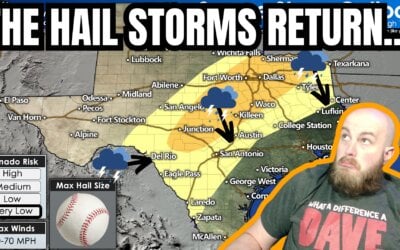
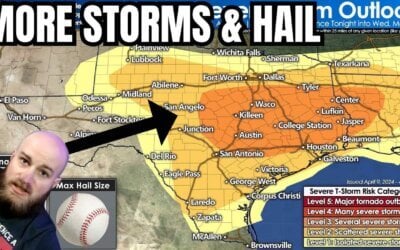
This graphic shows the probability of experiencing a severe thunderstorm within 25 miles of your location today and tonight. The brown shaded zones are what we consider a low risk, or a 5 percent chance. Within the yellow zone, the Storm Prediction Center has issued a standard risk of severe weather which means there is a 15 percent chance of experiencing severe weather within 25 miles of any given point. Thunderstorm coverage will be isolated across South Texas with a slightly higher coverage expected across North Texas.
The strongest storms will be capable of producing golfball size hail and damaging winds in excess of 60 MPH. However, all storms will be capable of producing cloud to ground lightning. As it is a Sunday and numerous outdoor events are planned, please keep that in mind. Thunderstorms should begin firing by 4 to 5 PM to the west of Interstate 35 and begin approaching Interstate 35 by 6 to 9 PM. Remember, expect the unexpected when it comes to thunderstorms and have a way to receive weather warnings later this afternoon, especially if you’re planning to be outdoors. When thunder roars, go indoors!
We’ll be chasing northwest of Fort Worth this afternoon and plan on following the storms back into the metroplex. We’ll have live video available after 1 PM.
A relatively small severe thunderstorm watch has been issued for portions of the Texas Hill Country until 10 PM. Thunderstorms are beginning to develop in an environment with extreme instability values but relatively weak windshear. This means that significant severe weather, such as tornadoes, are unlikely, but some hail and damaging downbursts are possible. 
THE NWS STORM PREDICTION CENTER HAS ISSUED A
SEVERE THUNDERSTORM WATCH FOR PORTIONS OF
CENTRAL TEXAS
EFFECTIVE THIS SATURDAY AFTERNOON AND EVENING FROM 505 PM UNTIL
1000 PM CDT.
HAIL TO 2 INCHES IN DIAMETER...THUNDERSTORM WIND GUSTS TO 70
MPH...AND DANGEROUS LIGHTNING ARE POSSIBLE IN THESE AREAS.
REMEMBER...A SEVERE THUNDERSTORM WATCH MEANS CONDITIONS ARE FAVORABLE FOR SEVERE THUNDERSTORMS IN AND CLOSE TO THE WATCH AREA. PERSONS IN THESE AREAS SHOULD BE ON THE LOOKOUT FOR THREATENING WEATHER CONDITIONS AND LISTEN FOR LATER STATEMENTS AND POSSIBLE WARNINGS. SEVERE THUNDERSTORMS CAN AND OCCASIONALLY DO PRODUCE TORNADOES.
DISCUSSION...A CLUSTER OF THUNDERSTORMS IS EXPECTED TO DEVELOP NEAR AND JUST E OF A DIFFUSE DRYLINE IN CENTRAL TX. FLOW ALOFT IS RELATIVELY WEAK/ANTICYCLONIC...BUT SURFACE TEMPERATURES NEAR 100 F AND DEWPOINTS IN THE MID 60S ARE CONTRIBUTING TO STEEP LOW-LEVEL LAPSE RATES AND MLCAPE NEAR 4000 J/KG. THE WEAK VERTICAL SHEAR SUGGESTS THAT INDIVIDUAL STORMS WILL NOT BE LONG-LIVED...BUT THE STEEP LAPSE RATES/LARGE CAPE WILL SUPPORT A RISK OF BOTH STRONG UPDRAFTS WITH LARGE HAIL...AND STRONG DOWNDRAFTS WITH DAMAGING WIND POTENTIAL THROUGH LATE EVENING.
After a somewhat busy weather day on Friday, we’re expecting a more localized, isolated severe weather threat for Saturday. The Storm Prediction Center has issued a standard risk of severe weather, shown in yellow, along and about 50 miles east of a dryline expected to be located from Del Rio, to San Angelo, to Vernon line. A strong cap will help to limit overall thunderstorm coverage and wind shear is going to be a tad less then Friday. Still, any thunderstorms that develop will have the potential to become severe with large hail and downburst winds possible. The most likely zone to see isolated thunderstorms will be between Interstate 10 and Interstate 20 in the yellow shaded zone, but one or two storms cannot be ruled out north of Interstate 20.