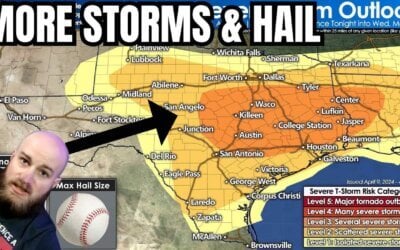
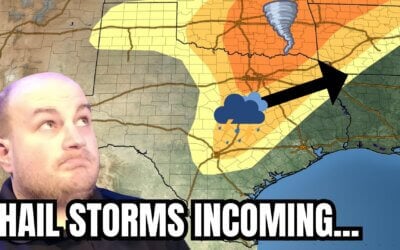
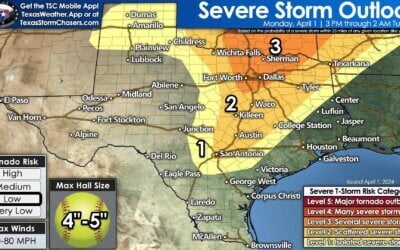
This graphic shows the chance of you experiencing severe weather within 25 miles of any given point today into tonight. The brown colors mean there is a relatively low chance of 5 percent and the yellow colors indicate what we refer to as the standard risk of severe weather, or a 15 percent chance. The Storm Prediction Center has placed the eastern portions of the Big Bend Country along with the western portions of the Hill Country in the standard risk of severe weather with the potential of isolated severe thunderstorms late this afternoon into the early evening hours.
This graphic shows the expected instability values at 7 PM this evening across Texas. The overall environment is expected to become very unstable along and east of the dryline this afternoon as Convective Available Potential Energy (CAPE) values excess 4,o00 joules per kilogram (J/Kg) in some locations. In non-nerdy terms, that’s very unstable! However, a strong cap will greatly limit the overall thunderstorm chances today. Only a few thunderstorms are expected in Texas today, but any thunderstorm that develops will likely become severe with large hail the primary threat. The storms should be confined to an area within 50 to 75 miles of the dryline, so they should remain well west of Interstate 35 as the cap will smash any storms that try to approach.
Much like Sunday, supercells are expected to develop over West Texas and further north into the Texas Panhandle during the late afternoon and evening hours. On Sunday, thunderstorms developed just east of the Texas/New Mexico border around 6:30 PM. Initially, there were only two storms west of Lubbock, both of which became prolific hail producers. After sunset, a number of storms developed further north as the low level jet helped increase warm air advection and the associated lift. The reason I mention this in detail is because those storms left boundaries all over the place. Later today those boundaries are going to act as focal points for new thunderstorms to develop.
Before I get even more nerdy, let me go ahead and outline today’s risk zones so folks who don’t care about weather too much can get on with their day. Above are several graphics showing the overall severe weather risk zones for today.
Brown Shaded Zones – 5% chance of severe weather within 25 miles of any given point (like your house/business). – Low Risk
Orange Shaded Zones – 15% chance of severe weather within 25 miles of any given point (like your house/business). – Standard Risk
Red Shaded Zones – 30% chance of severe weather within 25 miles of any given point (like your house/business). – Elevated Risk
The main severe weather threat at first will be very large, damaging hail. Across the elevated risk zones (red shading), there will also be a tornado threat and straight-line wind threat.
This graphic comes from the high resolution North American Model and shows projected instability values at 6 PM this afternoon. You can see the location of the dryline on this graphic, running along and east of Odessa to Lubbock and Amarillo line. You can see that the dryline bulges out between Amarillo and Lubbock. This feature is often helps increase forcing locally and develop thunderstorms to the east of that bulge. As a whole, instability values over 3,000 joules per kilgoram (J/Kg) support an organized severe weather threat, assuming that wind shear is in place.
This graphic comes from the same model for 6 PM Monday and shows Storm Relative Helicity. This algorithm helps meterologists determine the overall amount of spin available for storms. It looks like this one model has a warm front running along a Canyon, Childress, to Wichita Falls line. To the north of this warm front, wind shear values are over 300 m2/s2. Anything over 200 m2/s2 is favorable for organized thunderstorms, including supercells. To the south of this boundary, shear values are lower but still sufficant for slow moving supercell thunderstorms capable of producing big hail. The threat for tornadoes will be highest along any outflow boundaries left over from yesterday’s convection along with the warm front where shear increases. Additionally, some models are suggesting that a strong complex of storms may track along this warm front overnight. If that does materialize, not only will the threat of large hail continue but a considerable straight-line wind threat could also develop.
I would expect storms to begin developing by 5 PM in the Texas Panhandle and West Texas along the dryline with the possibility of quickly becoming severe. Remember that not everyone will see severe storms today, but refer to the outlook graphics above for the specific chances.
I’ll be chasing in Northwest Texas today and will have the live video feed running for what will end up being the last time on this specific website as our new site will be up sometime later this week.
Another stormy day is in store for portions of West Texas and the Texas Panhandle. This graphic shows the probability of experiencing severe weather within 25 miles of any given point (such as your house) this afternoon and during the evening hours. The brown colors represent a 5 percent chance while the orange shaded zone represents the main severe weather risk areas, where the standard 15 percent probability has been issued.
Like yesterday, not everyone will be affected by these thunderstorms. A few discrete thunderstorms will form during the early evening and perhaps congeal into a larger complex of thunderstorms. The strongest storms will be capable of producing large hail and perhaps a brief tornado. Strong outflow winds are also possible, especially if storms can organize into a line or complex later tonight.
The Storm Prediction Center has issued a risk of severe weather for much of Northwest Texas and western portions of North Texas for late this afternoon into the evening hours. The overall coverage of storms is in question because of a strong cap in place. I wouldn’t be surprised to see no storms today along the dryline, but if storms are able to form, ingredients are quite favorable for severe weather. Very large, damaging hail will be the main threat with any storm that is able to form this afternoon. A tornado is not out of the question. If storms are able to form into a cluster or complex this evening, the threat for damaging outflow winds would also increase.
We’ll have a better idea by noontime with how many storms we expect, or if we’ll even get any at all. Storms will remain northwest of D/FW as a strong cap will remain in place.
This graphic shows the probability of severe weather occurring within 25 miles of any given point (such as a house) on Thursday, April 26. A standard risk is defined as the yellow shaded zone with an elevated risk of severe weather within the red shaded zone. The black hatched zone means there is a chance of very large hail. I’ll be chasing tomorrow and will have live video up and running! I’ll also have a detailed discussion posted later this evening.
This is the Storm Prediction Center’s discussion that accompanies this outlook. Some of this discussion is pretty technical, so I’ve highlighted some of the text so the non-weather folks can understand it.
NWS STORM PREDICTION CENTER NORMAN OK 1227 PM CDT WED APR 25 2012 VALID 261200Z - 271200Z ...THERE IS A SLGT RISK OF SVR TSTMS ACROSS THE CNTRL/SRN HIGH PLAINS... ...CNTRL/SRN HIGH PLAINS... WELL DEFINED UPPER LOW OFF THE SRN CA/NRN BAJA COAST...CENTERED NEAR 29N/127W...WILL EJECT INLAND EARLY IN THE DAY2 PERIOD BEFORE LIFTING NEWD INTO CO/NM BY 27/00Z. THIS FEATURE WILL THEN SHIFT INTO THE HIGH PLAINS DURING THE OVERNIGHT PERIOD. AS THE TROUGH SHIFTS ACROSS THE ROCKIES LOW LEVEL FLOW WILL UNDOUBTEDLY RESPOND AND BECOME DECIDEDLY SELY ACROSS THE HIGH PLAINS. WHILE THE LATEST SHORT RANGE MODELS HAVE STRUGGLED RECENTLY REGARDING THE AGGRESSIVE BOUNDARY LAYER MOISTURE RETURN...IT APPEARS A LEGITIMATE MOISTURE SURGE WILL SPREAD ACROSS THE SRN PLAINS WARM SECTOR OVER THE NEXT 24-48HR AND 60-65 SFC DEW POINTS MAY BE IN PLACE ACROSS THE ERN TX/OK PANHANDLE REGION BY PEAK HEATING. TIMING OF THE UPPER TROUGH WILL FAVOR OVERNIGHT CONVECTION THOUGH STRONG BOUNDARY LAYER HEATING SHOULD CONTRIBUTE TO DESTABILIZATION WITHIN THE UPSLOPE REGION FROM THE TX PANHANDLE INTO EXTREME SERN CO. FOR THIS REASON IT APPEARS SCATTERED THUNDERSTORMS WILL BEGIN DEVELOPING AROUND 21-22Z (4 PM - 5 PM CDT). FORECAST SOUNDINGS SUGGEST SBCAPE COULD EASILY EXCEED 2000 J/KG WITHIN A SHEARED ENVIRONMENT THAT WILL STRONGLY SUPPORT SUPERCELLS. FAVORABLY SHEARED AND BACKED LOW LEVEL FLOW ALSO LENDS CREDENCE TO THE POSSIBILITY OF TORNADOES. HAVE INCREASED THE SEVERE PROBS ACROSS THE HIGH PLAINS TO ACCOUNT FOR THE LIKELIHOOD OF POTENTIALLY TORNADIC SUPERCELLS IN ADDITION TO VERY LARGE HAIL. LATE AFTERNOON/EVENING SUPERCELLS WILL ALSO DEVELOP FARTHER NORTH ACROSS ERN CO WITHIN STRONGER ZONE OF FORCED ASCENT. THIS ACTIVITY COULD EASILY SPREAD INTO SWRN NEB/NWRN KS BY MIDNIGHT AS LLJ INCREASES DURING THE OVERNIGHT PERIOD.